Choosing the right China Best Pegboard Displays requires more than comparing prices. Global buyers need dependable construction, accurate dimensions, flexible layouts, and clear communication from suppliers. A display may look impressive in a catalog, yet feel unstable under real retail pressure. That difference matters.
Lena Ortiz, a retail-fixture consultant with experience in international store projects, says, “A pegboard earns its place when every hook supports a buying decision.” Her observation is practical. Good Pegboard Displays should organize products clearly, use wall space efficiently, and allow quick merchandising changes. Steel panels, powder-coated finishes, reinforced edges, and compatible hooks can improve daily performance. However, specifications should never be accepted blindly. Ask for material thickness, weight capacity, surface treatment, packaging details, and installation guidance.
Small details matter.
A reliable Chinese manufacturer should provide samples, production photographs, inspection records, and consistent export packaging. Check whether accessories fit securely. Test the display with actual product weight. Consider humid warehouses, long shipping routes, and repeated assembly. These conditions reveal weaknesses early. Some buyers focus too heavily on the lowest quote. That choice can create replacement costs later.
Still, no supplier is perfect. Lead times may shift, colors may vary slightly, and sample quality may not represent every production batch. Buyers should document expectations and review each stage carefully. This guide examines practical options for China-made Pegboard Displays, including design flexibility, manufacturing quality, customization, packaging, and supplier reliability. The goal is not to promote one factory. It is to help global buyers make a more informed, measurable decision.
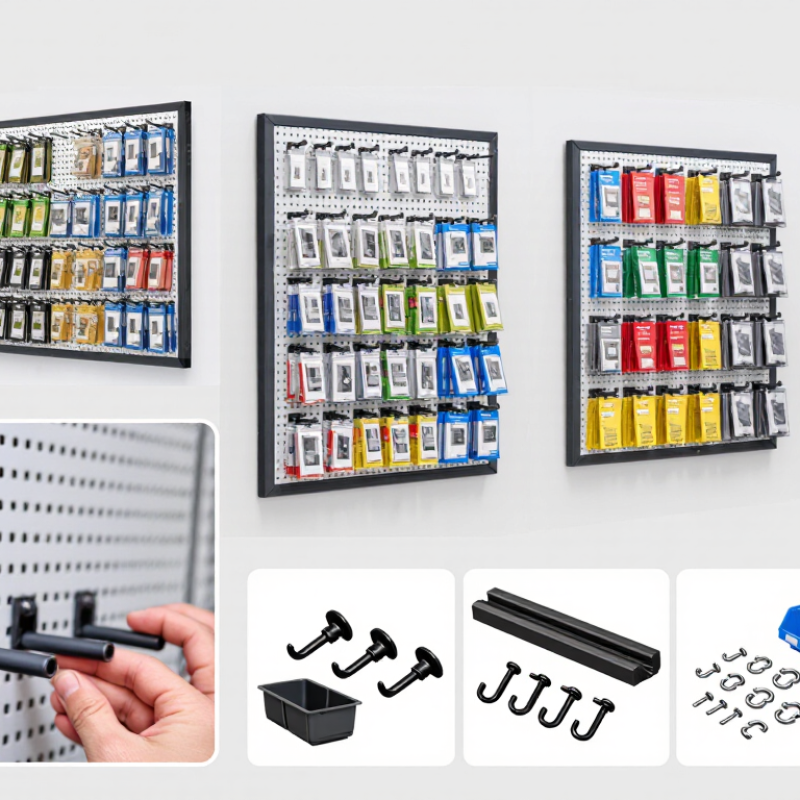
A pegboard display is a retail fixture with a perforated panel and adjustable hooks, shelves, or baskets. Its repeated holes create a flexible grid for presenting packaged goods, tools, accessories, and small household items. A typical unit includes a steel or wood panel, a supporting frame, base feet, and hardware. The panel carries the load, while the frame controls stability. Simple, but not weightless.
In stores, pegboards help organize products by size, use, or price range. Hooks can place packaged items at eye level, while baskets hold loose products without hiding them. A side panel may carry product instructions or a price card. Retail staff can change the layout quickly during seasonal campaigns. In fixture reviews, poor spacing appears often. Products overlap, labels disappear, and shoppers stop looking.
For global buyers, practical evaluation should cover panel thickness, hole spacing, coating quality, welds, load testing, carton protection, and replacement parts. Ask for drawings, material details, sample inspection records, and photographs of packed units. Confirm dimensions in millimeters, not assumptions. A display may look strong but bend after repeated loading. That lesson is easy to miss. Factories in China can offer varied finishes and production volumes, yet specifications must remain written and measurable. Minor color variation, assembly effort, or shipping damage can affect store performance. Leaving these risks unexamined is careless.
Pegboard displays work best when their structure matches the retail environment. In compact convenience stores, a slim wall-mounted panel keeps small products visible without blocking circulation. In supermarkets, double-sided pegboard gondolas create flexible aisles for seasonal promotions. Beauty shops often need smaller panels with adjustable hooks, shelves, and mirror-backed sections. Each format supports a different shopping rhythm.
Global buyers should also consider climate, transport, and installation. Powder-coated steel suits humid markets better than untreated board. Retailers in earthquake-prone areas may need reinforced bases and locked accessories. Flat-pack pegboards reduce shipping volume, but assembly quality can suffer. That detail is easy to underestimate. A loose hook can damage customer trust.
The 2024 NRF and Appriss Retail Returns Report valued U.S. retail returns at 743 billion dollars, equal to 14.5% of annual sales. This figure strengthens the case for modular displays, since retailers can reconfigure fixtures instead of replacing complete units. Grand View Research also identifies continued growth in retail shelving demand, driven by store modernization and space efficiency. For global projects, choose slotted panels for frequent product changes, perforated steel for heavier merchandise, and freestanding towers for temporary campaigns. Test each design with real packaging, not only drawings. A visually clean sample can become unstable after full loading.
China Best Pegboard Displays for Global Buyers
Key Materials, Dimensions, and Customization Options
For global buyers, a pegboard display should be judged by more than appearance. In factory sampling, we check panel flatness, hole alignment, edge finishing, and load performance. Powder-coated steel handles frequent fixture changes and humid retail spaces. Birch plywood feels warmer and suits boutiques, but it needs sealed edges. MDF is economical and easy to machine. It can swell if moisture enters. That detail is often underestimated.
Common panels measure 600 x 900 mm, 900 x 1200 mm, or 1200 x 2400 mm. Custom sizes are possible, but shipping cartons may become inefficient. Hole spacing commonly follows a 25 mm or 50 mm grid. Confirm the hook diameter before production. A small mismatch can make the display frustrating to use. Depth also matters. A 150 mm shelf needs stronger support than a simple hook. Ask for drawings showing tolerances, not only finished dimensions.
Customization can include color, printed graphics, rounded corners, lighting channels, lockable storage, and custom header boards. For export projects, request flame, coating, packaging, and material documentation suited to the destination market. Samples reveal problems that drawings hide. We once found a sharp rear edge after an otherwise acceptable sample review. It was corrected, but the inspection should have caught it earlier. Buyers should also test assembly time with real staff. A display that looks efficient may still require too many tools.
Common commercial pegboard formats are shown below. Steel panels are suited to higher-load applications, while MDF and plywood offer lighter-weight and more flexible display solutions.
Customization options: powder-coated steel, melamine-faced MDF, plywood, printed graphics, custom hole spacing, edge treatment, freestanding bases, casters, shelves, hooks and header panels. Typical hole spacing is 25 mm or 1 inch, depending on the market specification.
China Best Pegboard Displays for Global Buyers
How to Evaluate Chinese Pegboard Display Manufacturers
A reliable Chinese pegboard manufacturer should prove performance, not just show polished factory photos. I request a physical sample with the final steel thickness, hole spacing, hooks, and coating. A display may look strong but bend under real retail loads. Test it with weighted shelves and repeated hook movement. Ask for test records, material certificates, and a clear tolerance sheet.
Production systems matter. The ISO Survey 2023 reported more than one million ISO 9001 certificates worldwide, so certification alone does not prove factory capability. Check whether the certificate matches the legal manufacturer and production site. Review incoming-material inspection, welding controls, powder-coating thickness, and final packing records. A useful audit follows one order from raw steel to carton sealing. Small details expose weak control.
Logistics also deserves attention. The World Bank’s 2023 Logistics Performance Index ranked China 19th, showing strong national logistics capacity, but individual suppliers still vary widely. Request carton dimensions, gross weight, pallet drawings, and drop-test evidence. Compare the declared packaging with a packed sample. I have seen attractive displays arrive with scratched edges because separators were too thin. That mistake is avoidable, yet buyers often focus only on unit price. A signed pre-production sample, inspection plan, and replacement policy create better accountability. Still, no checklist is perfect. Regular inspections remain necessary.
| Evaluation Dimension | What Global Buyers Should Check | Practical Benchmark or Requirement | Recommended Evidence | Why It Matters |
|---|---|---|---|---|
| Panel Material | Steel, MDF, plywood, acrylic, or a mixed construction; verify thickness and surface quality. | Steel panels should have consistent thickness and a flat surface; wood-based panels should be free from swelling, delamination, and exposed edges. | Material specification sheet, mill certificate where applicable, and pre-shipment inspection photos. | Material selection affects load capacity, durability, appearance, and shipping weight. |
| Hole Pattern and Compatibility | Check hole diameter, hole spacing, panel orientation, and compatibility with hooks and accessories. | The manufacturer should provide drawings with dimensions in millimetres and confirm accessory compatibility before production. | Technical drawing, first-article sample, and accessory fit test. | Incorrect hole spacing can make otherwise suitable hooks unusable. |
| Load Capacity | Evaluate the safe working load of the panel, brackets, shelves, and hooks as a complete system. | Require a stated load rating for each component and test the display under the intended load, including an appropriate safety margin. | Load-test report, test method, product drawings, and photographs of the loaded unit. | A high-capacity panel may still fail if the brackets or wall anchors are underspecified. |
| Surface Finish | Inspect powder coating, paint, laminate, plating, or anodizing for uniformity and adhesion. | Finish should be free from visible runs, pinholes, sharp defects, uneven color, and exposed metal on customer-facing surfaces. | Approved color sample, coating specification, adhesion test result, and inspection checklist. | A consistent finish reduces corrosion risk and protects the visual presentation of merchandise. |
| Corrosion Resistance | Confirm whether the display will be used indoors, in humid areas, or in semi-outdoor environments. | For metal displays, specify coating type, pretreatment, and any required salt-spray or humidity test based on the destination environment. | Coating data sheet, pretreatment records, and relevant laboratory test report. | Humidity, transport condensation, and cleaning chemicals can accelerate corrosion. |
| Dimensional Accuracy | Measure panel width, height, hole positions, shelf alignment, and frame squareness. | Agree on drawing tolerances before mass production and use the approved sample as the visual and dimensional reference. | Inspection report with actual measurements and calibrated measuring tools. | Accurate dimensions improve assembly speed and prevent gaps between adjoining units. |
| Safety and Ergonomics | Check sharp edges, exposed fasteners, tipping risk, pinch points, and wall-fixing requirements. | Customer-facing edges should be deburred or protected, and freestanding units should include suitable anti-tip provisions. | Risk assessment, assembly instructions, and safety inspection records. | Safe construction reduces injury risk and supports compliance with retailer requirements. |
| Manufacturing Capability | Review cutting, punching, welding, bending, coating, printing, woodworking, and final assembly capabilities. | Prefer a controlled production process with documented quality checkpoints rather than relying only on final inspection. | Factory audit, process flow chart, equipment list, and quality-control records. | In-house process control can improve consistency and reduce coordination risk. |
| Quality Management | Determine how the manufacturer handles incoming materials, in-process checks, nonconformities, and corrective actions. | A documented quality system, traceable inspection records, and a defined corrective-action process should be available. | Quality manual, inspection plan, sample records, and independent factory-audit report. | Repeatable quality controls are important for large or recurring purchase orders. |
| Customization Capability | Assess custom dimensions, colors, graphics, shelves, hooks, lighting, bases, and modular configurations. | Require a written confirmation of which features are standard, modified, or newly engineered for the project. | Prototype, approved artwork, engineering change record, and tooling quotation. | Clear customization control helps prevent mismatched components and unapproved substitutions. |
| Packaging and Export Readiness | Review carton strength, internal protection, moisture protection, palletization, and labeling. | Packaging should protect corners, coated surfaces, glass or acrylic parts, and small accessories during international transit. | Packing specification, drop-test plan where required, carton marks, and loading photos. | Good export packaging reduces damage, claims, and installation delays. |
| Documentation | Check availability of assembly instructions, parts lists, drawings, care instructions, and replacement-part information. | Documents should use consistent part numbers and provide clear diagrams for assembly and installation. | English documentation package and digital copy of the approved technical file. | Complete documentation lowers installation errors and simplifies after-sales support. |
| Lead Time and Capacity | Separate sample lead time, production lead time, packaging time, and shipping time. | The quotation should state capacity assumptions, production schedule, order cut-off dates, and delay-notification procedures. | Production plan, capacity statement, order history summary, and written delivery commitment. | Accurate scheduling is essential for store openings, seasonal campaigns, and container planning. |
| Total Landed Cost | Compare product price with tooling, packaging, inland transport, freight, duties, inspection, installation, and replacement parts. | Request comparable quotations using the same specifications and agreed trade terms, such as FOB or CIF. | Itemized quotation, packing list, carton dimensions, HS-code support, and freight assumptions. | The lowest factory price does not always produce the lowest delivered cost. |
| Pre-Shipment Inspection | Define inspection quantity, sampling method, acceptable defect limits, and critical measurements before production. | Use an approved inspection checklist covering appearance, dimensions, function, quantity, packaging, and labeling. | Independent inspection report with photographs and measurement results. | Inspection before shipment provides an opportunity to correct defects before goods leave China. |
| After-Sales Support | Evaluate response time, spare-part availability, warranty terms, and handling of shortage or damage claims. | Warranty coverage, claim procedures, replacement-part pricing, and response times should be written into the purchase agreement. | Warranty document, service-level commitment, spare-parts list, and communication records. | Reliable support protects the buyer’s installation schedule and long-term operating cost. |
Buying pegboard displays from China requires more than comparing factory prices. The real work starts with matching the display to your retail environment. Ask for material samples, hole spacing, board thickness, edge finishing, and load data. A sample should hold the intended products without bending. Measure it yourself. Photos are not enough. Suppliers should explain material grades, coating methods, production capacity, and tolerances. Request a written quotation with packaging, tooling, inspection, and shipping terms clearly separated.
Quality control should happen before mass production, not after a container arrives. Approve a pre-production sample and record its dimensions, color reference, hardware count, and carton markings. An independent inspection can check random units, welds, surface scratches, stability, and assembly instructions. For wooden panels, inspect moisture and warping. For metal parts, check coating adhesion and sharp edges. Small defects become expensive when multiplied across thousands of units. Still, inspections have limits. A report cannot replace clear specifications or responsible follow-up.
Shipping needs equal attention. Confirm carton size, gross weight, pallet rules, and corner protection. Ask how displays will be nested or separated to prevent rubbing during transit. Compare sea, rail, and air options using the same delivery assumptions. Duties, import documents, insurance, and destination handling should be assigned in writing. Keep spare hardware in each shipment. It can save a store opening. Delays happen, even with careful planning. Build buffer time, and review the plan when port schedules change. The cheapest quote may become the costliest choice after damage, rework, or missed launch dates.
Powder-coated steel handles frequent fixture changes and humid retail spaces. Birch plywood feels warmer but needs sealed edges. MDF costs less, yet moisture can cause swelling. Choose based on the store environment, not appearance alone.
Common panel sizes include 600 × 900 mm and 900 × 1200 mm. Larger panels may reach 1200 × 2400 mm. Hole spacing often uses 25 mm or 50 mm grids. Confirm hook diameter before production.
Test the display with real products, weighted shelves, and repeated hook movement. A 150 mm shelf needs stronger support than a simple hook. Look for bending, loosened joints, and unstable bases. Photos cannot prove load capacity.
Options may include colors, printed graphics, rounded corners, lighting channels, lockable storage, and header boards. Ask for drawings showing tolerances. Finished dimensions alone are insufficient.
Request a physical sample using the final materials, coating, hooks, and steel thickness. Review welding controls, coating checks, material inspection, and packing records. Follow one order from raw material to carton sealing. Factory photos are not enough.
Record panel dimensions, color references, hardware quantities, carton markings, and assembly steps. Test assembly with actual staff and tools. A display may look simple but take too long to install. That problem is easy to miss.
Request carton dimensions, gross weight, pallet drawings, and corner protection details. Check separators between panels and metal parts. Thin separators can cause scratched edges. Compare the packed sample with the final shipment.
Inspect welds, surface scratches, stability, sharp edges, coating adhesion, and assembly instructions. Check moisture and warping on wooden panels. Independent inspection helps, but it cannot fix unclear specifications. Follow-up still matters.
Clarify transport method, duties, import documents, insurance, destination handling, and delivery assumptions. Build buffer time for port delays. Include spare hardware in each shipment. The cheapest quote may become expensive after damage or rework.
Pegboard Displays are flexible retail fixtures designed to organize, present, and promote products in stores, showrooms, trade spaces, and other commercial environments. Their modular structure typically combines a perforated panel with hooks, shelves, baskets, or holders, allowing products to be arranged efficiently and adjusted as merchandising needs change. This overview explains different pegboard display formats suitable for supermarkets, specialty shops, exhibitions, and compact retail spaces, while also covering common materials such as metal, wood, acrylic, and engineered panels. It discusses standard and custom dimensions, finishes, colors, graphics, accessories, and structural options for creating displays that match specific product categories and store layouts.
For global buyers, selecting a dependable Chinese manufacturer requires careful evaluation of production capabilities, design support, material quality, customization experience, communication, and quality-control procedures. The article also highlights essential sourcing considerations, including sample approval, detailed specifications, packaging protection, inspection before shipment, lead times, shipping methods, documentation, and cost planning. With a clear purchasing process and consistent quality checks, buyers can obtain practical, durable, and visually effective pegboard solutions for international retail applications.

FlexiRack