Shelving Boards look simple until a shelf bows under cookbooks, pantry jars, or a heavy tool case. In 2026, the best choice still depends on load, span, moisture, finish, and budget. Solid wood offers natural grain and can be refinished, while plywood often provides a stable, layered core. MDF creates a smooth surface for paint, but edges need protection from moisture. Particleboard can suit lighter-duty projects when properly supported. No single board wins every room.
Industry context matters, but market growth is not a performance test. Grand View Research valued the global furniture market at US$556.3 billion in 2023 and forecast 5.8% annual growth through 2030. That broad figure signals continued demand for furniture; it does not tell shoppers which shelf will resist sagging. For practical material context, the USDA Forest Products Laboratory’s Wood Handbook describes wood as “a hygroscopic material.” Wood-products researcher Robert J. Ross edited the handbook, underscoring why humidity belongs in any board comparison.
Small details matter. A board above a laundry sink faces different conditions from one in a dry study. Shelf depth, support spacing, and edge treatment can change the result as much as the material label. Check manufacturer load ratings, and avoid treating them as universal; installation and span affect performance. This guide compares common Shelving Boards by strength, moisture response, appearance, cost, and ease of installation. One limitation deserves honesty: published market reports rarely isolate shelving-board sales, and product claims vary. Measure twice. Choose for the actual load, not just the showroom sample.
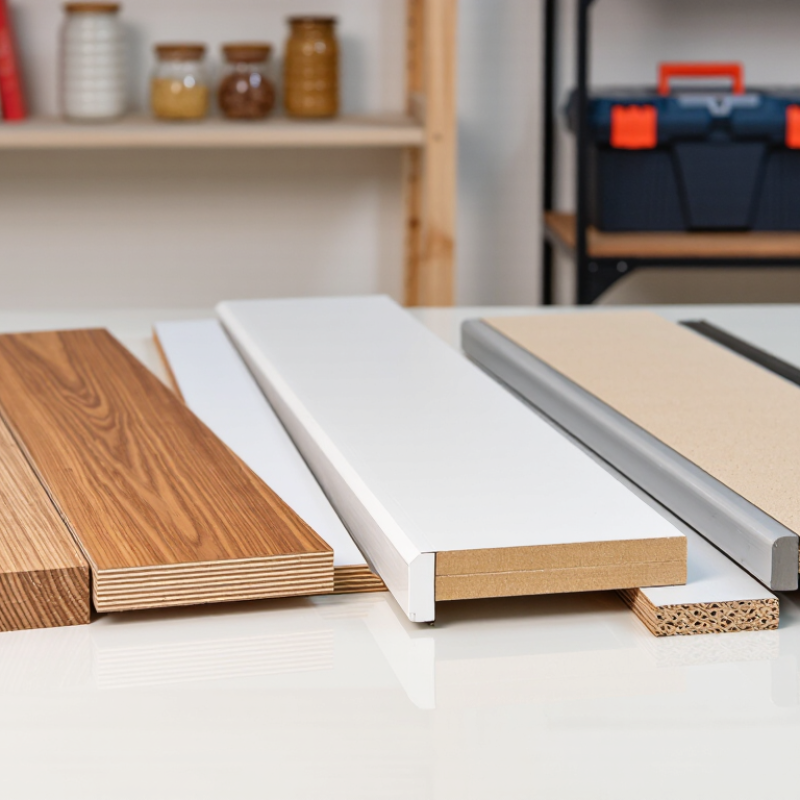
Choosing a shelving board starts with its load, span, and room conditions. Solid wood has visible grain and can be sanded or refinished. It may cost more, and seasonal humidity can cause movement. Plywood layers resist splitting and often provide a strong, stable surface. Check the board’s thickness and support spacing; even sturdy plywood can sag across a long, unsupported span. A useful detail: inspect the edges, not just the face.
MDF has a smooth surface that takes paint well, making it suitable for tidy indoor storage. However, it is heavy and can swell if moisture reaches unsealed edges. Particleboard is usually economical and works for lighter household items, but its fastener grip and moisture resistance may be limited. Metal shelving boards handle demanding storage well, though they can look less warm in a living space. There is no universal winner. The right choice depends on what the shelf will carry and how carefully it will be supported. A small test with the intended load can reveal problems before installation, though it cannot replace checking the board’s specifications.
Shelving boards in 2026 still come down to material, finish, and span. Solid wood offers a natural grain and can be refinished, but seasonal humidity may cause movement. Plywood’s crossed layers generally resist warping better than a single wide board. Its exposed edges may need banding or paint. MDF has a smooth face for painted shelves, though moisture can swell it. Edges matter.
A finish affects more than appearance. Laminate wipes clean and suits busy cupboards, but chipped corners are difficult to repair invisibly. Paint seals the surface when applied evenly, yet scratches can reveal the board underneath. Oil keeps wood grain visible, though it usually needs periodic care. Even a neat finish cannot compensate for a damp room or a poorly sealed edge.
Strength depends on thickness, material, support spacing, and the weight’s distribution. A long shelf holding heavy books may sag, even if it feels firm when empty. Check the maker’s load guidance, and place brackets near the ends and where the span needs support. Measure the actual wall, not just the plan. I’d be cautious about choosing the thickest board by appearance alone; added weight and cost do not always bring better performance.
How to Compare Strength, Durability, and Cost
The best shelving board depends on its load, span, and surroundings. A thick board can still sag if it stretches between widely spaced supports. Plywood often offers a useful balance of strength and price, while solid wood can be sturdy but costs more. MDF and particleboard are often budget-friendly, but check their stated load limits and protect them from moisture. Specifications matter more than appearance alone.
Durability is not just about resisting scratches. In a laundry room or garage, humidity and occasional spills can cause swelling or damage, especially along unsealed edges. For books or heavy tools, check the maker’s load guidance and support spacing. Then compare the full cost, including brackets, finishing, and possible replacement. I still think it is easy to overvalue a low price; a board that bows after a few months is no bargain.
For dry pantry shelves, plywood offers a useful balance of stiffness and screw-holding strength. Choose a panel suited to its support spacing, not just its thickness. APA’s Engineered Wood Construction Guide uses span ratings to help match panels with support conditions. Particleboard can suit evenly supported shelves carrying light, stable items. It is less forgiving when edges get wet. MDF gives paint a smooth surface, but a long, heavily loaded shelf may sag. It happens.
For a workshop, solid wood handles repeated adjustments and visible edge wear, though its movement with humidity deserves attention. The USDA Forest Products Laboratory’s Wood Handbook places wood’s fiber saturation point at roughly 30% moisture content; below that point, changing moisture levels can affect its dimensions. Keep boards away from damp walls, and seal exposed edges where spills are likely. A neat-looking board is not automatically a durable one.
Measure the clear span, then consider what the shelf will actually hold: jars, folded towels, or dense toolboxes behave differently. Leave a little room for brackets and uneven walls. I would test one shelf before cutting a full set; calculations rarely capture every wobbly corner.
| Shelving Material | Best Uses | Common Thickness | Main Advantages | Limitations | Support and Selection Guidance |
|---|---|---|---|---|---|
| Solid hardwood | Visible living-room shelves, bookcases, and furniture projects | ¾–1½ in (19–38 mm) | Strong, durable, repairable, and available in attractive natural grain | Usually costs more than sheet goods; can expand or contract as humidity changes | Choose a board suited to the intended finish. Add a center support for long spans or heavy loads. |
| Solid softwood | Utility shelving, closets, garages, and painted storage | ¾–1½ in (19–38 mm) | Widely available, easy to cut and fasten, and generally less expensive than hardwood | May dent or bow more readily than hardwood, depending on species, grade, and board dimensions | Inspect boards for straightness and defects. Use brackets or a center support where loads or spans are substantial. |
| Plywood | General-purpose shelves, cabinets, workshops, and built-in storage | ½–¾ in (12–19 mm); ¾ in is a common choice for shelves | Layered construction provides good strength and dimensional stability; can be cut to custom sizes | Exposed edges may need banding or trim; quality and surface finish vary by grade | For heavier everyday storage, ¾ in plywood is a practical starting point. Support the front edge or shorten the span if sagging is a concern. |
| MDF (medium-density fiberboard) | Painted shelves, cabinets, and indoor projects requiring a smooth surface | ½–¾ in (12–19 mm) | Smooth, consistent surface; easy to machine and paint; usually free of knots and grain patterns | Heavy for its size, can sag over long spans, and may swell if exposed to moisture | Use indoors in dry conditions. A thicker board, shorter span, or front-edge stiffener helps control deflection. |
| Particleboard | Budget shelving and enclosed storage in dry rooms | ⅝–¾ in (16–19 mm) | Economical and commonly available with a smooth or laminated surface | Edges can chip; fasteners may hold less securely than in plywood or solid wood; moisture can cause swelling | Use adequate supports and avoid damp locations. Do not assume a laminated surface makes the core water-resistant. |
| Melamine-faced particleboard | Closets, pantry shelving, and clean, ready-to-use cabinet interiors | ⅝–¾ in (16–19 mm) | Pre-finished, wipe-clean surface; does not require painting for typical indoor use | Cut edges need finishing; the particleboard core is vulnerable to swelling if water reaches it | Seal exposed edges, protect from standing water, and provide support appropriate to the shelf span and stored load. |
| Wire shelving | Laundry rooms, pantries, closets, and ventilated storage areas | Not applicable; typically supplied as a metal shelf assembly | Allows airflow, is lightweight, and is easy to clean | Small items may need shelf liners; suitability depends on the complete shelf system and its installation | Follow the system’s published load rating and installation instructions. Secure wall supports into suitable framing or approved anchors. |
Selection note: Shelf capacity depends on material grade, thickness, depth, span, support spacing, fastening, and how weight is distributed. Check the manufacturer’s specifications for engineered products and shelving systems; for heavy loads, use shorter spans and additional supports.
Choosing the right shelving board begins with its job, not its appearance. For books, tools, or pantry jars, estimate the total weight and measure the unsupported span. Longer spans can sag, especially with heavy loads. Solid wood is sturdy and easy to refinish, while plywood offers stable layers and reliable screw holding. Particleboard can suit light storage, but moisture and concentrated weight may damage it. Small details matter.
Measure twice. Check wall studs with a stud finder, then mark their centers clearly. If the shelf must attach to masonry or drywall without a stud, select anchors rated for the expected load and follow their instructions. Board thickness, bracket spacing, and fastener choice work together; a thick board alone cannot prevent a weak installation. Cut the board square, sand rough edges, and seal exposed surfaces where spills or humidity are likely. Even careful measurements can miss an uneven wall, so test the fit before fastening everything.
Use a level to align brackets, and keep the shelf slightly clear of doors or trim. Tighten screws firmly, but stop if the board begins to split. Load the shelf gradually and watch for bowing over the next few days. If it flexes, reduce the span or weight rather than hoping it settles. It is easy to overlook how much books weigh. Recheck fasteners after the first week, especially on shelves holding frequently used items.
Typical density of common shelving-board materials
Values are approximate representative densities in kg/m³; actual density varies by wood species and manufactured product. Density alone does not determine shelf strength. For a sturdy shelf, consider board thickness, unsupported span, support spacing, expected load, and suitable fasteners. Solid wood, plywood, MDF, and particleboard can all work when properly specified and supported.
Plywood offers stiffness and good screw-holding strength for jars and dry goods. Match the panel to its support spacing.
It can work for evenly supported shelves with light, stable items. Keep water away from its edges.
MDF provides a smooth surface for paint, but long shelves can sag under heavy loads. It happens.
Measure the unsupported span and estimate the load. Jars, folded towels, and toolboxes place different demands on a shelf.
Shorten the span, add supports, or reduce the weight. Watch for bowing after loading the shelf gradually.
Find wall studs and mark their centers. For other wall types, choose anchors rated for the expected load.
Keep it away from damp walls and seal exposed edges where spills may occur. Check for moisture after use.
Use a level, test the fit, and leave clearance near doors or trim. Recheck the fasteners after the first week; I sometimes forget.
Choosing the best Shelving Boards in 2026 means balancing strength, durability, appearance, and cost. Common options include solid wood, plywood, particleboard, and metal, each offering different levels of load capacity, moisture resistance, and ease of customization. The core material, surface finish, board thickness, and support spacing all affect how well a shelf performs over time. Comparing these features helps match a board to both the items it will hold and the conditions of the room.
For light decorative storage, an affordable engineered board may be suitable, while heavier loads often call for a thicker, sturdier material with reliable support. Kitchens, garages, and damp areas may require finishes that are easier to clean or more resistant to moisture. Before choosing, measure the space, estimate the expected load, and consider the desired look and maintenance needs. Install the board level, use appropriate brackets or supports, and follow safe load limits to create shelving that is practical and dependable.

FlexiRack