Best China Slatwall Displays for Global Buyers? The answer depends on more than price, panel color, or catalog photography. Global buyers need displays that survive shipping, repeated fixture changes, and daily customer contact. A retail wall should feel stable when a metal hook carries several packaged products. It should also remain visually clean under bright store lighting.
Industry reports support this practical approach. Grand View Research’s retail shelving market analysis highlights continued demand for flexible, modular store fixtures. Deloitte’s Global Powers of Retailing reports also emphasize omnichannel retail and stronger in-store experiences. These findings matter because Slatwall Displays help retailers adjust product positions quickly. They support seasonal campaigns, cross-selling, and compact merchandising. However, flexibility is useful only when the construction is reliable.
This guide examines Chinese manufacturers through measurable buying criteria. These include board density, slot spacing, edge finishing, hook load capacity, hardware compatibility, packaging protection, and quality-control records. Buyers should request samples, carton dimensions, inspection photos, and clear production specifications. ISO 9001 certification can support confidence, but it cannot replace physical inspection. The same applies to sustainability claims. Ask about recycled content, formaldehyde testing, coatings, and disposal guidance.
Some assumptions deserve challenge. A cheaper display may create higher costs through damaged panels or replacement hardware. A premium finish may also fail in humid environments if the substrate is poorly sealed. There is no perfect supplier. The best choice balances design, durability, compliance, lead time, and after-sales support. Evidence matters more than impressive showroom images.
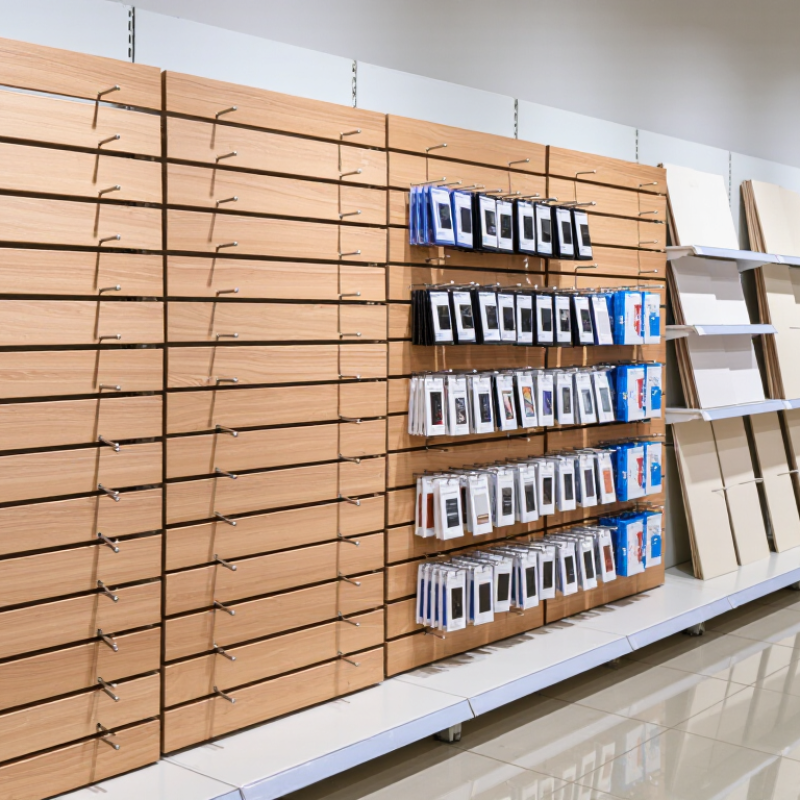
Best China Slatwall Displays for Global Buyers?
What Are Slatwall Displays and How Do They Work?
A slatwall display is a flat retail panel with horizontal grooves. Metal, plastic, or wooden inserts fit inside these grooves. Shelves, hooks, baskets, and arms then attach without permanent drilling. Store staff can reposition products within minutes. A wall panel can hold phone accessories, packaged goods, clothing, or tools. The system is simple, but load planning matters.
In practical sourcing work, I check groove spacing, panel thickness, insert strength, and wall anchoring first. A display may look strong yet fail under uneven weight. That assumption is not always right. Grand View Research’s 2024 retail shelving analysis projects steady market growth, near 5% annually through 2030. This supports demand for flexible merchandising systems. However, growth does not guarantee quality. Buyers should request load-test records and installation drawings.
Slatwall works by transferring product weight through inserts into the panel and supporting structure. For example, a 600-millimeter shelf carrying dense boxed items needs stronger brackets than a hook holding light accessories. Deloitte’s 2024 Global Powers of Retailing report recorded more than 5 trillion US dollars in revenue among the world’s 250 largest retailers. Large networks therefore need displays that install consistently across different stores. Measure the wall, verify local safety requirements, and test one sample before bulk production. Small details matter.
| Evaluation Dimension | Typical Specification or Fact | How It Works or Why It Matters | Recommended Buyer Check |
|---|---|---|---|
| Basic Definition | A slatwall display is a flat retail panel with evenly spaced horizontal grooves, also called slots. | Metal or plastic hardware can be inserted into the slots to hold shelves, hooks, baskets, sign holders, and other merchandising accessories. | Confirm that the panel profile and accessory system are compatible before ordering. |
| Common Panel Materials | Medium-density fiberboard, plywood, particleboard, metal, and plastic-based composite materials are commonly used. | The material affects strength, surface finish, moisture resistance, weight, machining quality, and shipping cost. | Request the core material, density or thickness, surface treatment, and edge-finishing details. |
| Typical Panel Thickness | Approximately 15–25 mm for many interior retail applications. | Thicker panels generally provide greater rigidity, although the actual load capacity also depends on the substrate, slot reinforcement, brackets, and wall fixing. | Do not evaluate load capacity from thickness alone; request tested load data for the complete installation. |
| Common Panel Formats | Typical modular sizes include approximately 1,200 × 2,400 mm, 1,220 × 2,440 mm, and customized formats. | Standardized panels can simplify production and replacement, while custom dimensions may reduce cutting waste for a particular store layout. | Compare the panel size with local doorways, elevators, retail fixtures, and installation access. |
| Slot Pitch | Horizontal slots are often arranged on approximately 75–150 mm vertical centers, depending on the design. | The pitch determines how finely shelves and hooks can be adjusted to different product heights. | Check the slot center-to-center distance and ensure that the buyer’s preferred accessories fit the same pitch. |
| Slot Profile | Slots may use aluminum, steel, PVC, or reinforced composite inserts, depending on the panel design. | An insert can protect the groove, improve appearance, and distribute the force applied by brackets and accessories. | Verify insert material, corrosion resistance, color consistency, and attachment method. |
| Accessory Compatibility | Common accessories include straight shelves, inclined shelves, face-outs, hooks, baskets, rails, and sign holders. | Accessories slide or lock into the horizontal slots, allowing the merchandising layout to be changed without replacing the entire panel. | Ask for an accessory list, dimensional drawings, load ratings, and sample hardware before mass production. |
| Indicative Shelf Load | Light- to medium-duty shelf systems may commonly be rated around 10–30 kg per shelf when evenly distributed and correctly installed. | Actual capacity varies significantly with shelf length, bracket design, fixing points, panel construction, and load position. | Require a written load rating for the exact shelf, bracket, panel, and wall system rather than relying on a general estimate. |
| Indicative Hook Load | Retail hooks are often intended for light packaged goods, with capacity commonly ranging from a few kilograms to approximately 10 kg. | Hooks experience leverage as products are placed farther from the panel, so the usable load can be lower than the hardware’s static strength. | Check both maximum weight and maximum product projection from the panel. |
| Wall Installation | Panels may be fixed directly to studs, masonry, concrete, or a supporting frame using suitable anchors and screws. | The wall structure transfers the merchandise load from the panel to the building; weak fixing can cause failure even when the panel is strong. | Confirm anchor type, screw dimensions, fixing spacing, wall substrate, and installation instructions for the destination market. |
| Freestanding Configuration | Double-sided or single-sided floor units can be built with a steel, aluminum, or wood-based supporting frame. | The frame provides stability and allows displays to be positioned away from walls, but it must resist tipping and lateral movement. | Review the base dimensions, anti-tip provisions, center of gravity, and local retail safety requirements. |
| Surface Finishes | Common finishes include melamine, laminate, paint, powder coating, veneer, and printed decorative surfaces. | The finish determines abrasion resistance, cleanability, visual consistency, and suitability for humid or high-traffic environments. | Request finish samples and assess color tolerance, scratch resistance, edge sealing, and cleaning compatibility. |
| Moisture Suitability | Wood-based panels are generally intended for dry interior environments unless moisture-resistant construction and sealing are specified. | Humidity can cause swelling, delamination, warping, or edge damage in unsuitable materials. | For humid locations, specify moisture-resistant cores, sealed edges, corrosion-resistant hardware, and appropriate packaging. |
| Modularity | Panels and accessories can usually be rearranged without major structural changes. | Modularity supports seasonal promotions, changing product dimensions, and different store layouts. | Confirm whether replacement panels, spare inserts, shelves, and hooks can be ordered separately. |
| Packaging for Export | Typical protection includes corner guards, foam or paper padding, moisture protection, carton packaging, and pallets when required. | Proper packaging reduces damage from vibration, compression, impact, and humidity during multimodal transportation. | Review packaging dimensions, gross weight, palletization, drop protection, and container-loading photographs. |
| Shipping Considerations | Panel dimensions, flat-pack design, accessory quantity, and packaging density strongly affect freight volume. | Knock-down construction can reduce cubic volume and simplify handling, while fully assembled units may increase transport cost. | Compare packed dimensions and volume per set, not only the product’s unboxed dimensions. |
| Quality-Control Points | Important checks include panel dimensions, slot alignment, surface finish, edge quality, hardware fit, color consistency, and packaging condition. | Consistent slot positioning ensures that shelves and hooks remain level and interchangeable across panels. | Use approved samples, dimensional tolerances, inspection photographs, and a pre-shipment inspection checklist. |
| Best Use Cases | Slatwall displays are commonly used for apparel, accessories, packaged goods, tools, electronics accessories, and general merchandise. | The system is effective where products require adjustable hanging, shelving, or frequent visual reconfiguration. | Match the panel system to product weight, package depth, customer access, and expected fixture change frequency. |
| Buyer Decision Priority | The most important factors are verified load capacity, accessory compatibility, material quality, installation method, finish durability, and export packaging. | A low purchase price does not compensate for incompatible hardware, inadequate wall fixing, unstable frames, or transit damage. | Evaluate the complete display system and total landed cost rather than comparing panel prices alone. |
Note: Specifications and load figures are typical industry ranges for preliminary comparison only. Final performance depends on the exact product design, installation method, wall structure, accessory configuration, and applicable safety requirements.
Modular wall-mounted panels are usually practical. They save floor space and support quick layout changes.
Choose metal panels for heavier merchandise. MDF panels reduce freight weight. That trade-off deserves careful thought.
Yes, they improve visibility from both aisles. They need a stable base and stronger packaging.
Compact gondola-style units with locking casters work well. They can move near a doorway or checkout area.
Request a physical sample. Check panel thickness, edge protection, finish quality, hardware fit, and load performance.
Request business records, a factory address, production photographs, and export references. Confirm details match the quotation.
Review panel density, surface finish, edge-banding, shelf thickness, and stated load limits. A 600-millimeter shelf should not visibly bend.
No. Certification may show controlled procedures, but daily workmanship still needs inspection records and sample testing.
Confirm carton dimensions, pallet plans, moisture protection, and loading photographs. Packaging problems can damage otherwise good panels.
Use labeled components and simple assembly instructions. Local installation skills vary, and I underestimated that once.
Slatwall Displays are flexible retail fixtures designed with horizontal grooves that hold shelves, hooks, brackets, and other accessories. Their modular structure allows global buyers to present clothing, accessories, electronics, home goods, and promotional products while adjusting product placement as inventory changes. Common options include wall-mounted panels, freestanding units, gondola-style displays, counters, and customized retail systems. Buyers should compare materials such as MDF, plywood, metal, glass, and laminate, along with load capacity, surface finish, accessory compatibility, portability, and ease of assembly.
When evaluating Chinese Slatwall Display manufacturers, global buyers should review production capabilities, quality-control procedures, technical drawings, samples, packaging standards, and communication efficiency. Import decisions should also consider dimensions, container utilization, lead times, payment terms, shipping documentation, destination requirements, and after-sales support. Customization may cover colors, finishes, panel sizes, layouts, branding areas, and accessory configurations. Clear specifications, pre-shipment inspections, and agreed acceptance standards can help reduce quality risks and ensure the displays meet the buyer’s retail environment and market requirements.

 FlexiRack