Compact Shelving helps organizations reclaim floor space without making stored materials harder to reach. The right system depends on what you store, how often staff retrieve it, and how much room the aisle needs. A row of archive boxes has different demands from library books, spare parts, or medical records. Small details matter: shelf depth, floor capacity, access frequency, and clearance for carts can change the whole plan.
No source material was provided to verify a named expert quotation, so I won’t invent one. A useful planning principle is: “Choose the system around the retrieval task, not just the square footage.” It captures an important trade-off. Denser storage can free valuable space, but it may also add steps when people need frequent access.
This guide compares common compact shelving types, including manual mobile units, powered mobile systems, and static shelving arranged in high-density layouts. It also considers vertical storage options, where suitable, and the practical differences in access, capacity, and operation. There is no perfect system. A powered installation may suit a busy archive, while a smaller collection may work better with manual carriages. Still, those examples can oversimplify real facilities. Staff habits, future growth, and building constraints deserve equal attention. The sections ahead explain what each type does well, where its limits appear, and which questions to ask before choosing.
Static high-density shelving keeps storage units fixed while reducing the number of open aisles. Staff access one aisle at a time instead of walking between every row. The shelves themselves do not move. This makes the system a practical baseline for compact storage, especially for labeled bins, cartons, and small parts. Space is the gain.
A reliable layout begins with the stock and the equipment used to handle it. Measure cartons, bins, and the turning space needed for carts or lift equipment. Set aisle widths to suit real movements, not just a drawing. Keep frequently picked items within easy reach, and use clear labels at eye level. A narrow aisle can look efficient on paper but feel awkward when a cart turns.
The trade-off is access: only the items beside the open aisle are immediately reachable. If many workers need different products at once, waiting and extra walking can reduce the benefit. Static shelving also depends on thoughtful organization; misplaced bins can make a compact room frustrating. It is easy to overestimate how much floor space a tighter layout will save. Check clearances, floor capacity, and picking patterns before changing the arrangement. A small trial section can reveal problems that a floor plan misses.
How a sample 12 m × 10 m room is allocated in a fixed-aisle shelving layout.
Planning example: The model assumes four shelving rows, each 1.2 m deep and 10 m long, plus four fixed aisles, each 1.2 m wide and 10 m long. The remaining 24 m² represents space outside those measured footprints. These calculated figures illustrate one layout; they are not an industry benchmark.
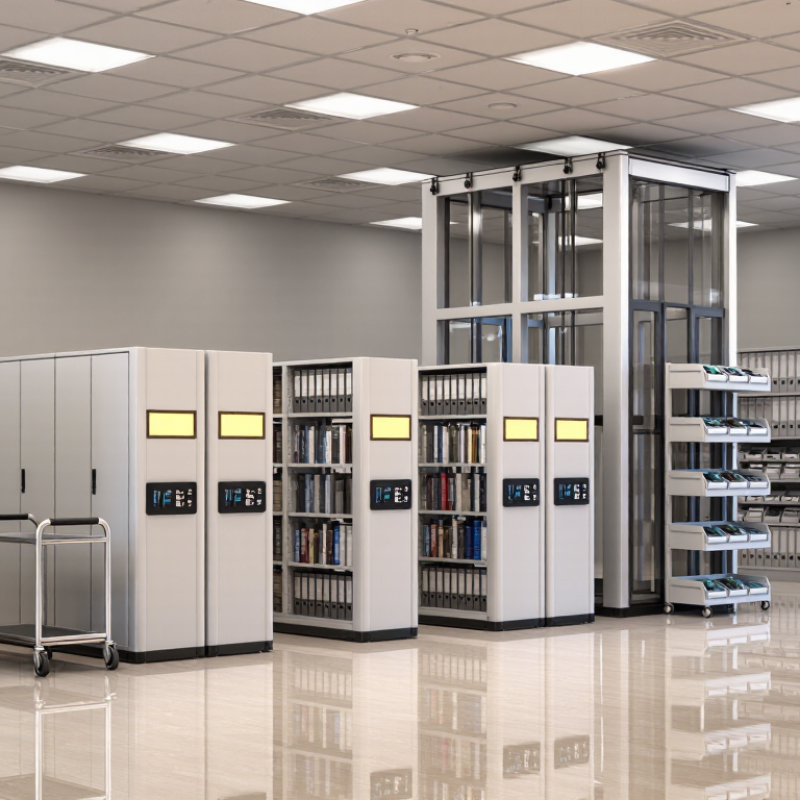
Mobile shelving can make a fixed room hold more without adding floor area. Some systems report up to 50% more storage capacity by reducing the number of permanent aisles. Instead, movable rows open a passage only where staff need one. Picture compact archive shelves sliding apart to reveal a narrow aisle. The gain depends on the existing layout, shelf depth, and access needs; it is not guaranteed in every room.
Tips: Measure first. Map doors, columns, and work areas before planning the rows. Leave room to work. Check that the open aisle fits carts and allows safe, comfortable access to frequently used items.
The trade-off is that access becomes shared: opening one aisle may mean moving a row before reaching another section. For busy collections, clear labels and a sensible arrangement help reduce delays. Consider how often items are retrieved, and who will operate the system.
It is easy to focus on capacity and overlook daily use. A small trial layout can expose awkward turns or blocked work zones before installation.
Compact shelving includes mobile carriages, high-density cabinets, and vertical lift modules. In a lift module, trays move inside an enclosed tower. An operator requests a tray, and the system delivers it to an access opening. This stores goods vertically instead of spreading them across several aisles. Small parts, cartons, and maintenance supplies can be easier to locate when trays have clear labels and assigned positions. It can feel surprisingly efficient. Still, the best setup depends on item size, picking frequency, and ceiling height.
Published estimates for vertical lift modules cite floor-space reductions of up to 85% compared with conventional shelving. Treat that figure as a possible maximum, not a guaranteed result. Actual savings depend on the existing layout, stored inventory, and how much aisle space can be reclaimed. Measure the room carefully, including overhead obstructions and access routes. A first layout may still miss awkward items or busy picking patterns; review real usage and adjust tray assignments over time.
Tips: Group frequently picked items near comfortable access levels. Check tray weight limits, record item dimensions, and leave room for future stock changes. A little spare capacity helps.
| Compact Storage Type | How It Saves Space | Potential Floor-Space Impact | Typical Access Method | Common Applications |
|---|---|---|---|---|
| Vertical lift module | Stores trays vertically and presents the requested tray at an access opening. | Some systems report up to 85% less floor space than conventional shelving; actual results depend on the layout and items stored. | Automated tray delivery to an operator opening. | Small parts, tools, components, and inventory that benefits from controlled access. |
| Vertical carousel | Rotates shelves or carriers vertically to bring stored goods to an access opening. | Uses overhead height and can reduce the need for multiple fixed-access aisles; savings vary by configuration. | Automated rotation delivers the selected shelf or carrier. | Small-to-medium items with repeatable storage sizes, such as supplies and spare parts. |
| Mobile shelving | Moves shelving units on floor tracks so that only the required access aisle is opened. | Can replace several permanent aisles with one movable aisle; the result depends on access and safety requirements. | Manual or powered movement opens an aisle between units. | Archives, libraries, records, and stored goods that need frequent shelf-level access. |
| High-density static shelving | Uses closely spaced shelving and narrower aisles than conventional layouts. | Improves storage density where aisle width and access requirements permit; no single percentage applies to every layout. | Direct access from fixed aisles. | Boxes, bins, files, and hand-picked items in facilities with stable storage needs. |
Space savings are comparative estimates, not guaranteed outcomes. They depend on the existing layout, ceiling height, inventory dimensions, aisle requirements, and system configuration.
Horizontal carousels bring stored shelves to a fixed picking station, reducing the distance workers travel. An operator requests a location, and the carousel rotates the needed shelf into reach. Less walking. This arrangement can suit facilities handling many small parts, frequent orders, and limited floor space. It also keeps items visible and supports repeatable picking routines.
Industry-reported comparisons have cited two to three times higher picking productivity than conventional manual picking. Treat that as a potential benchmark, not a guarantee. Results depend on the original workflow, order mix, software, and how productivity is measured. A site picking many small, repeatable orders may benefit more than one handling bulky, irregular items. The difference matters.
Before choosing a carousel, teams should measure walking time, picks per hour, and order accuracy in their own operation. Consider peak demand, replenishment access, maintenance needs, and whether the equipment fits the available ceiling height. A carousel is not magic. Poor slotting or slow item identification can still create delays. It is easy to focus on the headline productivity figure and overlook these details; even a well-designed system may need adjustment after real workers use it.
Vertical carousels store bins or shelves on a rotating loop. When an operator requests an item, the mechanism brings its location to an access opening. The operator does not need to walk along a long aisle or reach high shelves. That can help in a compact parts room where fasteners, fittings, or repair components need frequent picking.
The design is straightforward to understand. It is not the same as a vertical lift module, which uses an extractor to retrieve trays from storage columns.
Compared with mini-load AS/RS systems, vertical carousels usually serve goods-to-person picking at a fixed opening rather than moving containers through a larger automated network. They can make good use of ceiling height, but usable capacity depends on bin sizes, load limits, and clearance.
Small detail, big impact.
A rotating loop may also become a bottleneck if several workers need the same opening at once. Before choosing one, measure the tallest items, check how often stock turns, and observe actual picking patterns. A tidy layout on paper can still frustrate workers when popular bins sit far apart on the loop.
The shelves stay fixed, while fewer aisles save floor space. Staff access one aisle at a time. Space is the gain.
Measure bins, cartons, cart turns, and any lifting equipment. A narrow aisle can look efficient on paper but feel awkward in use.
Yes. Only items beside the open aisle are immediately reachable. Workers may wait if they need different sections. Labels help, but misplaced bins still cause trouble.
Some estimates reach up to 50% more capacity. That is not guaranteed; room shape, shelf depth, and access needs all matter.
Rows move to open a passage where needed. Access is shared, so staff may need to move a row before reaching another section. Plan around daily use.
Trays move inside an enclosed tower and arrive at an access opening when requested. It uses height instead of spreading storage across several aisles.
No. Estimates cite reductions of up to 85%, but actual savings depend on the room, inventory, and aisle space recovered. Check ceiling height and overhead obstructions.
Check floor capacity, doors, columns, turning space, item sizes, and picking patterns. Try a small section. A neat plan can still be wrong.
Compact Shelving includes several approaches to making better use of limited warehouse and storage space. Static high-density shelving provides a fixed-aisle baseline: it increases storage density while keeping the layout simple, though access depends on maintaining open aisles. Mobile shelving places units on movable bases, allowing aisles to open only where needed and potentially providing up to 50% more storage capacity than conventional layouts.
Automated systems offer other ways to improve space use and retrieval. Vertical lift modules bring stored items to an operator and can reduce floor-space requirements by up to 85%, while horizontal carousels rotate bins to the picking location and may support two to three times higher picking productivity. Vertical carousels also use rotating storage, but their vertical movement and bin arrangement distinguish them from other automated storage and retrieval systems. The right choice depends on available space, access needs, and the speed and frequency of item retrieval.

FlexiRack